
 How to Choose Multi-Pendant Lights for Dining Tables & Kitchen Islands
Lighting is no longer merely a functional necessity in modern residential architecture; it has become the literal anchor of interior design.[cite: 1] In contemporary open-concept floor plans—where traditional walls are removed to foster seamless transition between the culinary workspace and the social dining area—overhead illumination serves as the invisible boundary definer.[cite: 1] It establishes visual zones, dictates mood, and reflects personal style.[cite: 1] However, achieving the perfect balance overhead is notoriously challenging.[cite: 1] Homeowners frequently fall into the trap of installing an overbearing single chandelier that shrinks the room, or scattering detached individual fixtures that lack cohesive rhythm.[cite: 1] The multi-pendant light has emerged as the definitive design solution, effortlessly bridging sculptural artistry with flawless illumination.[cite: 1] This comprehensive guide details how to size, scale, position, and select multi-pendant configurations to elevate your home.[cite: 1]
1. The Evolution of Illumination: Why Multi-Pendants are Dominating Modern Design
The skyrocketing popularity of multi-pendant lighting among high-end interior designers is rooted deeply in the principles of architectural harmony, linear rhythm, and visual balance.[cite: 1] Historically, the standard approach to illuminating a rectangular dining table or an elongated kitchen island involved centering a single massive chandelier or a solitary large pendant directly over the surface.[cite: 1] While highly effective for square or circular tables, this traditional approach reveals severe limitations when applied to linear configurations.[cite: 1] A solitary overhead light source naturally creates a concentrated cone of brightness directly beneath it, leaving the outer perimeter of the surface blanketed in dim shadows while subjecting the center to uncomfortable glare.[cite: 1] This uneven distribution fails basic functional requirements for task-oriented environments like kitchens.[cite: 1]
Multi-pendant light fixtures fundamentally solve this physical limitation by distributing multiple distinct light sources along a singular structural axis.[cite: 1] By spreading illumination evenly across a horizontal plane, they eradicate dark zones and ensure that every inch of a kitchen counter or a long dining surface receives uniform, functional, and aesthetically pleasing light.[cite: 1] This layout provides exceptional task lighting for precise kitchen preparation while establishing a soft, flattering ambiance for lingering dinner parties.[cite: 1]
Beyond their unparalleled functional mechanics, multi-pendants possess a profound visual edge over singular light fixtures.[cite: 1] In interior design theory, the repetition of shapes establishes a rhythmic cadence that guides the observer's eye naturally through a space.[cite: 1] When multiple light heads are aligned symmetrically or clustered dynamically, they create an architectural "canopy of light" that gracefully lowers the perceived ceiling height.[cite: 1] This subtle spatial manipulation makes cavernous, double-height, or open-concept living zones feel instantly intimate, secure, and human-scaled.[cite: 1] Rather than cluttering the overhead void, a beautifully designed multi-pendant acts as a unifying centerpiece, creating a polished look that pulls disparate design elements into a unified whole.[cite: 1]
2. Deciding the Head Count: Tailoring 1-Head, 3-Head, and 5-Head Configurations to Your Space
Determining the ideal number of individual light heads—commonly referred to as the head count—represents the critical decision matrix for homeowners and design professionals alike.[cite: 1] This choice is rarely a matter of simple aesthetic preference; instead, it demands a deliberate calculation of scale, proportion, physical constraints, and the specific intended utility of the room.[cite: 1] Selecting an inappropriate head count can instantly distort a room's balance, making an expensive light installation appear either claustrophobically massive or awkwardly trivialized by its surroundings.[cite: 1]
The Bold Statement of the 1-Head Pendant
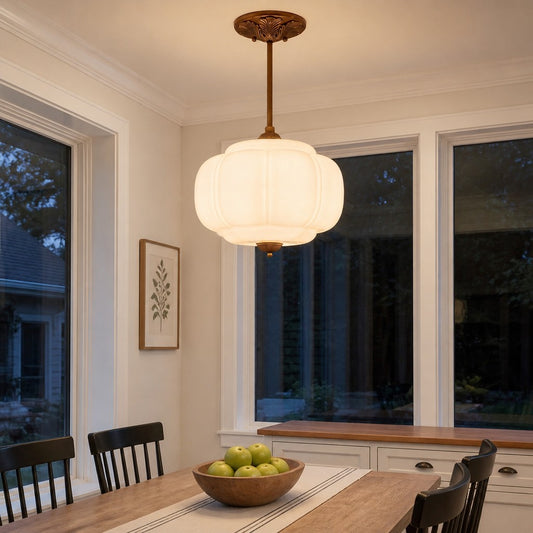
While multi-pendants are popular for linear surfaces, a perfectly scaled 1-head pendant configuration delivers a clean, focused, and uncompromisingly minimalist aesthetic.[cite: 1] This setup is highly effective for compact kitchen islands spanning under 5 feet in length, or small, intimate round dining tables.[cite: 1] In design history, a solitary focal point represents stability and restraint.[cite: 1] A single-head fixture works beautifully within hyper-minimalist, Scandinavian, or modern industrial interiors where simplicity is paramount.[cite: 1] Because it features only one primary light source, it avoids visual cluttering, making it an excellent alternative when working with lower ceilings or tight spatial boundaries where an elongated multi-head fixture would overcrowd the overhead field of view.[cite: 1]
The Golden Rule: The 3-Head Pendant and the Rule of Threes
The three-head multi-pendant stands undisputed as the absolute gold standard of interior lighting design.[cite: 1] This overwhelming popularity is directly linked to the fundamental psychological principle known as the "Rule of Threes."[cite: 1] Human cognitive architecture naturally seeks patterns, and our brains are hardwired to find odd numbers—particularly three—inherently more visually engaging, dynamic, and balanced than even groupings.[cite: 1] A trio of lights establishes a clear beginning, middle, and end, creating a natural visual progression that feels complete yet full of energy.[cite: 1] A three-head multi-pendant is the ideal pairing for standard-sized kitchen islands (ranging from 6 to 8 feet) and typical six-to-eight-seater dining tables.[cite: 1] It guarantees extensive, overlapping pools of illumination that fully cover the primary working or dining surface without demanding an overbearing amount of vertical or horizontal real estate.[cite: 1]
The Grand Statement: 5-Head (and Beyond) Multi-Pendants
For expansive homes, grand estates, or commercial scale spaces, a five-head (or larger) multi-pendant configuration is required to achieve appropriate scale.[cite: 1] When an island extends past 9 feet, or when a formal dining room features a magnificent ten-to-twelve-seater table, a standard three-head fixture will appear swallowed by the vastness of the space.[cite: 1] A five-head light fixture functions effectively as a custom sculptural art installation.[cite: 1] It commands authority, comfortably occupies massive overhead voids, and projects an undeniable aura of low-key luxury.[cite: 1] It distributes soft illumination across an expansive plane, turning a long countertop into an theatrical stage for cooking, dining, and socializing.[cite: 1]
The Functional Divide: Dining Tables vs. Kitchen Islands
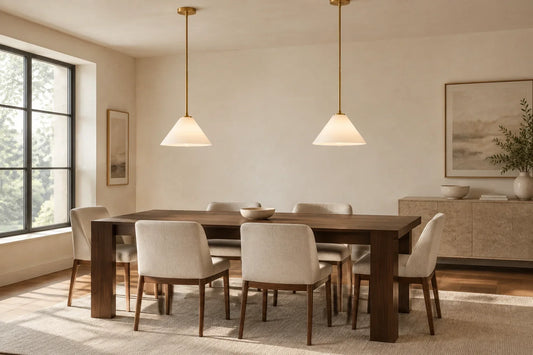
When finalizing your head count, you must analyze the core differences between the culinary island and the dining table.[cite: 1] A kitchen island is predominantly a high-performance workspace.[cite: 1] It demands crisp, shadow-free task lighting to facilitate safe food preparation, chopping, reading recipes, and casual morning tasks.[cite: 1] Consequently, kitchen islands generally benefit from highly structured, linear multi-pendant layouts that track the precise length of the counter.[cite: 1] Conversely, a dining table is a sanctuary for relaxation, slow conversation, and hospitality.[cite: 1] It requires warmer, diffused ambient lighting that flatters human faces and softens the environment.[cite: 1] For dining spaces, multi-head fixtures with organic clusters or single-canopy linear arrays featuring tinted or frosted glass are highly preferred, as they prioritize mood and glare prevention over intense task illumination.[cite: 1]
3. The Definitive Sizing, Spacing, and Hanging Height Guide
Even the most breathtaking, masterfully crafted designer light fixture will look completely out of place if its physical measurements clash with the architecture below.[cite: 1] To remove the guesswork from your installation, you must adhere strictly to established design mathematics.[cite: 1] These sizing and positioning rules ensure your multi-pendant functions flawlessly while maintaining perfect structural proportions within your home.[cite: 1]
The Linear Width Formula
The most common error homeowners commit is choosing a fixture that is either far too small—resulting in an underwhelming appearance—or excessively large, which creates a top-heavy, precarious atmosphere.[cite: 1] To achieve ideal proportion, remember this definitive rule: The total width of your multi-pendant fixture (measured from the absolute outer edge of the first light head to the outer edge of the final head) should measure between 1/2 and 2/3 the total length of the table or island beneath it.[cite: 1]
For example, if your kitchen island measures exactly 72 inches (6 feet) in length, your multi-pendant fixture should feature an overall span between 36 and 48 inches.[cite: 1] This ensures that the light source comfortably illuminates the outer perimeters of the counter while guaranteeing that the physical fixture never feels like it is visually spilling over or threatening the edges of the furniture below.[cite: 1]
The Vertical Clearance Rule
Hanging height dictates both the operational safety and the atmospheric success of your lighting design.[cite: 1] If pendants are suspended too low, they block crucial line-of-sight views across the room, obscuring faces during conversation and turning into an annoying physical hazard.[cite: 1] If hung too high, the light source becomes completely disconnected from the furniture below, scattering light wastefully into the upper room and exposing bare bulbs to the eyes, causing blinding glare.[cite: 1]
The universal baseline standard dictates that the bottom edge of the pendant shades must sit exactly 30 to 36 inches above the surface of your kitchen countertop or dining table, assuming a standard 8-foot or 9-foot ceiling height.[cite: 1] If your home features exceptionally tall ceilings (10 feet or higher), a helpful rule of thumb is to elevate the pendants by approximately 3 inches for every single additional foot of ceiling height.[cite: 1] This modification preserves vertical symmetry without sacrificing essential light concentration.[cite: 1]
The Mathematical Balance of Spacing
For multi-pendants that utilize separate, independent mounting points, or to evaluate pre-spaced single-canopy systems, maintaining a consistent mathematical gap is vital.[cite: 1] Light heads should be spaced evenly from one another, typically maintaining a distance of 24 to 30 inches apart from center to center.[cite: 1] Furthermore, to keep the arrangement grounded, ensure that the outermost light heads remain pulled back at least 6 to 12 inches from the absolute physical ends of the table or island.[cite: 1] This border space creates an invisible boundary that frames the lighting composition elegantly.[cite: 1]
| Surface Length (Island/Table) | Recommended Head Count | Ideal Overall Fixture Width | Standard Hanging Height (Above Surface) |
|---|---|---|---|
| Up to 5 Feet (Under 60") | 1-Head (Standard or Oversized) | 16" to 24" (Diameter) | 30" to 34" |
| 6 to 8 Feet (72" - 96") | 3-Head Linear / Multi-Port Cluster | 36" to 54" | 30" to 36" |
| 9 Feet + (108"+) | 5-Head Linear / Extended Canopy | 54" to 72" | 32" to 36" |

4. Style Pairings: Integrating Multi-Penders with Interior Aesthetics
A multi-pendant light shouldn't just fit mathematically; it must harmonize with the overarching interior design language of your home.[cite: 1] Because these fixtures possess significant visual presence, their materials, finishes, and silhouettes will immediately reinforce or conflict with your design style.[cite: 1]
Modern Minimalist & Contemporary
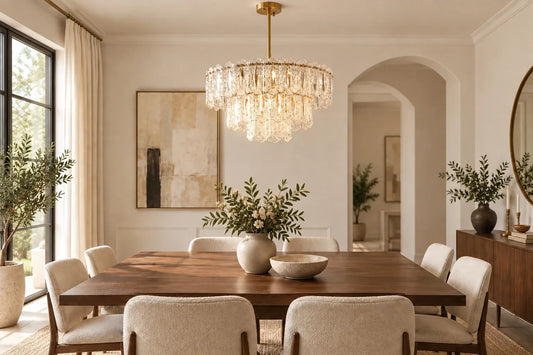
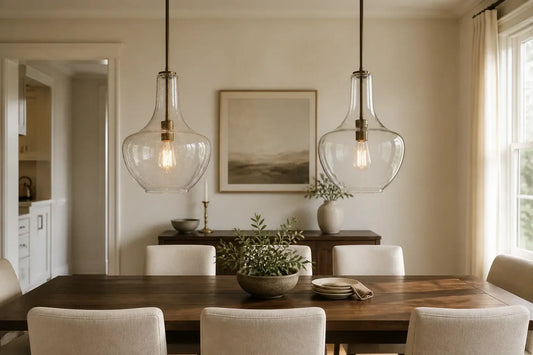
Modern minimalist spaces celebrate clean lines, hidden hardware, architectural restraint, and an emphasis on pure materiality.[cite: 1] In these settings, multi-pendants featuring ultra-slim linear profiles and glass components are highly successful.[cite: 1] Spherical hand-blown glass globes or crisp geometric glass rectangles hung from a slim, matte black or brushed brass canopy provide a weightless, floating effect.[cite: 1] The transparency of glass ensures that crucial sightlines across an open-concept kitchen remain entirely uninterrupted, making small rooms appear substantially larger while adding an element of quiet, low-key luxury.[cite: 1]
Transitional & Modern Farmhouse
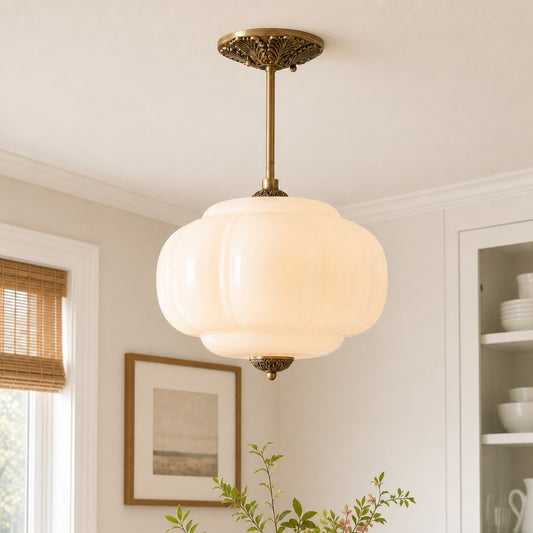
Transitional design seeks to merge the inviting warmth of traditional aesthetics with the sleek simplicity of contemporary forms.[cite: 1] For these spaces, look for multi-head configurations that pair metal structures with milk glass, frosted globes, or tapered clear glass shades.[cite: 1] A multi-pendant featuring soft oil-rubbed bronze or antiqued nickel arms holding warm, frosted glass shades provides the perfect textural bridge, softening the harshness of modern stainless steel appliances while feeling clean and organized.[cite: 1]
Industrial Chic
Industrial interiors draw raw inspiration from historic factories, converted urban warehouses, and unrefined materials.[cite: 1] Multi-pendant lighting for these environments relies heavily on thick iron piping, distressed metal canopies, woven fabric cords, and completely clear, heavy-duty glass enclosures.[cite: 1] Pairing these rugged structures with warm, amber-tinted Edison-style LED filament bulbs produces an inviting, amber glow that beautifully accentuates exposed brickwork, raw concrete, and reclaimed timber surfaces.[cite: 1]
5. Seamless Integration: Discovering Your Perfect Multi-Pendant Solution
When implementing a multi-pendant design layout, homeowners inevitably confront a major electrical obstacle: installation logistics.[cite: 1] The traditional method of hanging multiple individual pendants requires a licensed electrician to slice through drywall, install multiple independent junction boxes, run complex parallel wiring webs, and patch, smooth, and repaint the ceiling.[cite: 1] Achieving absolute, millimeter-perfect alignment across multiple independent boxes is notoriously difficult; a minor fractional variance will leave your expensive new lights looking permanently crooked and unprofessional.[cite: 1]
This is where the engineering brilliancy of a single-canopy multi-pendant system becomes an absolute lifesaver.[cite: 1] These masterfully designed fixtures consolidate multiple pre-aligned light heads onto a single, cohesive mounting plate or track.[cite: 1] This canopy attaches effortlessly to one single standard existing ceiling junction box—the exact same standard overhead box left behind by builders or old single chandeliers.[cite: 1] This innovation means you can achieve a sprawling, multi-light designer look without the dirty, destructive house renovations and expensive electrical labor bills.[cite: 1]
Featured Design Solution: Modern Minimalist Multi-Head Glass Pendant Light
If you are looking for an elegant balance of structural simplicity, visual light weight, and effortless installation, the Modern Minimalist Multi-Head Glass Pendant Light stands out as a premier choice.[cite: 1] This exceptional fixture features hand-blown glass shades suspended from a single, beautifully finished low-profile canopy.[cite: 1] Because the glass enclosures are completely transparent, they allow light to radiate a full 360 degrees, providing ample illumination for kitchen tasks while keeping your room's open sightlines clear and unobstructed.[cite: 1] It serves as a stunning showcase of how multi-head engineering can elevate everyday spaces into upscale design statements.[cite: 1]
Ultimately, selecting the right multi-pendant lighting is a rewarding journey that blends mathematical precision with personal design expression.[cite: 1] By carefully assessing your space’s length, calculating the appropriate head count for your functional needs, and prioritizing fixtures that simplify the installation process, you can transform your dining area or kitchen island into a beautifully illuminated haven.[cite: 1]
Frequently Asked Questions (FAQ)
How high should I hang my multi-pendant light?
The bottom edge of the pendant shades must sit exactly 30 to 36 inches above the surface of your kitchen countertop or dining table, assuming a standard 8-foot or 9-foot ceiling height.[cite: 1]
How wide should the multi-pendant fixture be compared to the table?
The total width of your multi-pendant fixture should measure between 1/2 and 2/3 the total length of the table or island beneath it.[cite: 1]
What is the "Rule of Threes" in lighting design?
The "Rule of Threes" is a psychological principle where odd numbers, particularly three, are visually more engaging and dynamic.[cite: 1] A three-head multi-pendant is the ideal pairing for standard-sized kitchen islands (6 to 8 feet) and dining tables.[cite: 1]
Do I need to rewire my ceiling to install a multi-pendant light?
Not necessarily. If you choose a single-canopy multi-pendant system, it consolidates multiple light heads onto one cohesive track that attaches effortlessly to a single standard existing ceiling junction box, avoiding destructive house renovations.[cite: 1]
Tags:
Previous
Milk Glass Lighting: The Perfect Blend of Vintage and Modern
Next
Rustic Lighting Ideas: Add Character with Industrial Style Metal Fixtures