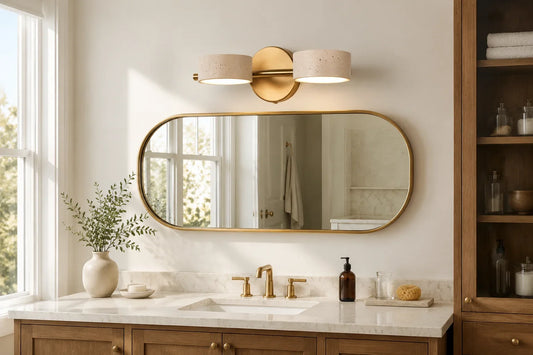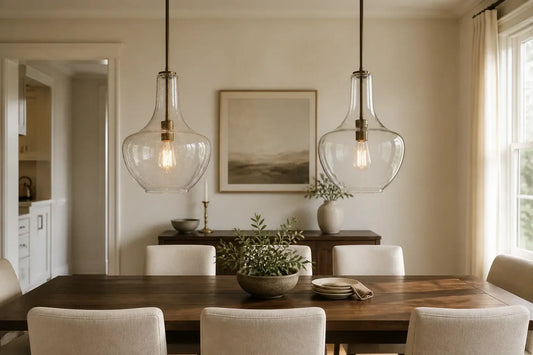

Quick Answer: Recommended Height
Pendant height / The measurement that matters
Start with the bottom of your pendant 30-36 inches above a dining table or kitchen island: 2.5-3 feet, or approximately 76-91 cm. Measure from the finished tabletop or countertop to the fixture's lowest point. Use this as a design starting range, then check sightlines, light coverage, ceiling constraints, and the manufacturer's installation instructions.
For a dining table, test the view while seated. For an island, test both standing work and seated conversation. The same above-surface range produces different heights above the floor because the furniture is different.
| Surface and use | Bottom-of-fixture starting position |
|---|---|
| Dining table, typically 30 in high2.5 ft / 76 cm above the floor | 30-36 in above the table. About 60-66 in (5-5.5 ft / 152-168 cm) above the floor. |
| Kitchen island, typically 36 in high3 ft / 91 cm above the floor | 30-36 in above the counter. About 66-72 in (5.5-6 ft / 168-183 cm) above the floor. |
| Raised bar, typically 42 in high3.5 ft / 107 cm above the floor | Begin around the same 30-36 in above-surface range, then test the stool sightline. About 72-78 in (6-6.5 ft / 183-198 cm) above the floor. |
Measure your actual furniture; these surface heights are examples. The ranges apply over fixed furniture, not open walkways, stairs, cooktops, or wet locations. Those situations require separate clearance and installation checks.
Height Over a Dining Table
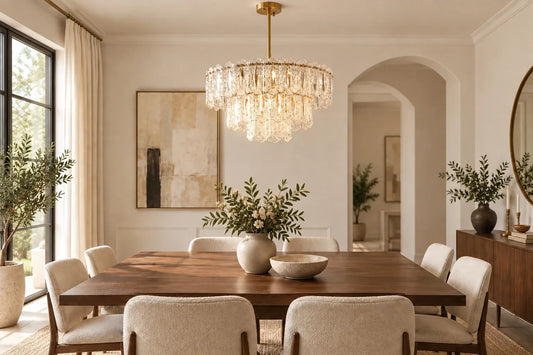
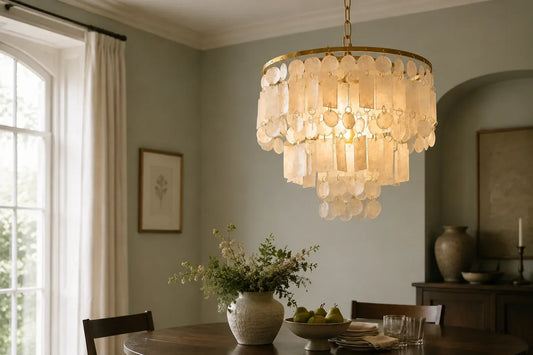
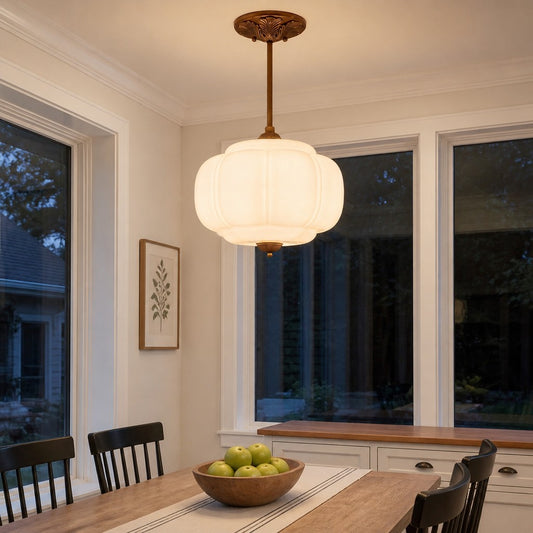
A dining pendant should connect visually to the table without interrupting the people around it. Start at 32 inches (2.67 ft / 81 cm) above the tabletop, within the 30-36-inch range. Hold a lightweight paper mock-up at that position before your electrician fixes the suspension length.
Sit at each end and along both sides. Can you see the person opposite? Does a bare bulb shine directly into your eyes? Can a taller guest stand up without approaching the shade? Test with the table in its everyday position, including any extension leaves you regularly use. Center the lighting on that table arrangement.

Calculate the total drop before choosing a fixture
Overall installed drop = ceiling height - surface height - desired clearance.
Example: 96 - 30 - 32 = 34 inches of total drop (2.83 ft / 86 cm). In centimeters, using unrounded inputs: 243.84 - 76.20 - 81.28 = 86.36 cm.
The drop runs from the ceiling to the lowest part of the installed light. It includes the canopy, suspension, connectors, and fixture body. A listing's rod or cord length is only one component. Compare your calculated result with the exact variant's minimum and maximum installed height.
The Ambrose Brass Glass Cone Pendant offers 8- and 14-inch shade options with clear or milk glass. Its listing gives an overall height range of 17.1-81.1 inches for the 14-inch shade. A 34-inch target falls within that published range; confirm the supplied suspension can achieve your precise setting before installation.

Height Over a Kitchen Island
An island combines standing work, stool seating, and views through the kitchen. Begin 30-36 inches (76-91 cm) above the countertop, and test near the upper end if a broad shade obstructs the standing view. Do not keep raising it solely to solve glare: bulb visibility and shade design may be the real issue.
Stand where you prepare food, look toward the sink or living area, then sit on each stool. A comfortable arrangement keeps conversation open while directing useful light onto the counter. If shadows remain, assess the bulb's lumens, beam, and supporting task lighting. Height alone cannot establish adequate work light.

With a 9-foot ceiling (108 in / 274 cm), a 36-inch island (91 cm), and a 34-inch clearance (86 cm), the total drop is 38 inches (3.17 ft / 97 cm). Two nearby pendants above a lower dining table may need different suspension lengths even if you choose the same clearance above each surface.
The Ava Opal Glass Pendant has a listed 15-inch width and 11.75-inch body height. That body height does not confirm whether it can achieve a 38-inch installed drop. Request the suspension range and check the selected configuration before ordering. Compare other shapes in the Pendant Lamps collection with the same measurement in hand.

Spacing Multiple Pendants
Choose shade diameter and count together. Three pendants are not automatically better than two. Start with the usable island length, allow room at both ends, then calculate equal center spacing. Keep every shade over the surface and check that the light pattern suits where you work.
Center spacing S = (L - 2E) / (N - 1), for two or more evenly spaced pendants.
L is surface length; E is the distance from each end to the nearest pendant center; N is pendant count. For identical shades of diameter D, the clear gap between shades is G = S - D. The margin from an island end to the nearest shade edge is E - D/2.

For a 96-inch island (8 ft / 244 cm), three 12-inch shades (30 cm), and outer centers 18 inches (46 cm) from the ends: S = (96 - 36) / 2 = 30 inches (2.5 ft / 76 cm). The edge gap is 30 - 12 = 18 inches (46 cm); the end edge margin is 18 - 6 = 12 inches (30 cm).
This is a layout example, not a required spacing rule. If you change to the 15-inch Ava pendant at the same centers, the gaps shrink to 15 inches (38 cm) and the end margins to 10.5 inches (27 cm). Reassess visual density, then mark centers before electrical work. A single pendant simply centers on the intended surface; the formula does not apply when N equals one.
Adjusting for Tall or Low Ceilings
Tall ceilings: use the extra height in the suspension
A taller ceiling increases the required drop; it does not automatically require the shade to sit much higher above the table. Keep a useful above-surface clearance as your first test, then adjust for scale and sightlines. The familiar suggestion to add height for every extra ceiling foot is a styling heuristic, not an installation requirement.
For a 10-foot ceiling (120 in / 305 cm), 36-inch island, and 34-inch clearance, you need 50 inches of overall drop (4.17 ft / 127 cm). Check maximum suspension length, approved extension parts, and structural support. Do not improvise extensions or assume an adjustable cord is long enough.
Low ceilings: check the minimum installed height
At a 7.5-foot ceiling (90 in / 229 cm), a 36-inch island and 34-inch clearance leave only 20 inches (1.67 ft / 51 cm) for the whole fixture. A tall body or fixed minimum rod may exceed that allowance. Consider a compact pendant or browse Ceiling Lamps if suspension cannot fit comfortably.
The Mini Flower Ceramic Light offers pendant and flush-mount options. Its pendant listing describes an adjustable 47-inch cord; that is not its minimum installed height. Confirm the exact version and complete dimensions rather than treating the two mount types as interchangeable.
Sloped ceilings: confirm the hardware and each drop
Measure ceiling height at each mounting point. To align pendant bottoms above a level island, suspension lengths may differ. The Winston Milk Glass Globe Pendant is listed as sloped-ceiling compatible, but confirm the permitted slope and supplied mounting parts. Have an electrician verify the installation, support, and applicable local requirements.
Choosing Pendant Diameter
Choose width alongside height: a wide shade can block views even at a conventional clearance. For a single pendant, begin by keeping it comfortably inside the tabletop edges, then test a paper silhouette at its full width. Room dimensions alone are a poor substitute for the furniture directly beneath the fixture.
Available diameter = surface width - 2 x desired side margin. This is a geometric fit check, not a brightness formula.
For a 42-inch-wide table (3.5 ft / 107 cm), trying a 12-inch margin on each side gives 42 - 24 = 18 inches (46 cm). The 12-inch margin is your trial layout choice, not a universal requirement.
For a row of pendants, use both the crosswise margin and the center-spacing formula. Compare the 8- and 14-inch Ambrose shades with the 12.25-inch-wide Winston. A smaller diameter leaves more visual space; it does not necessarily produce less light. Check the light source separately.

Common Installation Mistakes
- Measuring to the wrong point. Use the lowest fixture component, including any finial, and measure from the finished surface.
- Ordering by cord length alone. Add the fixture body, canopy, and connectors; verify both minimum and maximum installed height.
- Marking centers before choosing shades. Diameter changes the clear gap and the end margins. Lay out both before moving junction boxes.
- Checking only from the doorway. Test seated and standing views, glare, cabinet doors, and actual work positions.
- Using height to fix every lighting problem. Review source output, shade opacity, dimming compatibility, and other task lighting.
- Forgetting support and access. Use a qualified electrician for hardwired work. Confirm suitable mounting support, manufacturer instructions, and safe cleaning access.
Before installation, write down ceiling height, surface height, chosen clearance, total drop, shade width, and center positions. Photograph the mock-up from a stool and a standing work position. Share those measurements with your installer and use Merge Lighting's Size & Installation guide for the next checks.
FAQs
Is 30 inches above an island too low?
It is the lower end of a common starting range. It may work for a compact shade, but a broad fixture or taller user may need more clearance. Mock up 30, 33, and 36 inches (76, 84, and 91 cm), then compare views and useful light.
Can pendants hang 40 inches above a counter?
Sometimes, if the proportions, sightlines, and light coverage support it. Forty inches is about 3.33 ft or 102 cm. Test it rather than assuming a high ceiling requires it; an exposed bulb may become more visible from below.
Should all pendant bottoms be level?
A level row is a useful starting arrangement over one flat island. Measure each light from the counter, especially under a sloped ceiling. Deliberate staggered compositions need separate checks for the lowest light and the resulting light distribution.
How do I convert the measurements?
One foot equals 12 inches; one inch equals exactly 2.54 cm. Multiply inches by 2.54 for centimeters, or divide centimeters by 2.54 for inches. The centimeter equivalents here are rounded for reading; calculate the final drop with unrounded measurements.
How many pendants should I buy?
There is no fixed count for every island length. Compare diameter, gaps, end margins, light coverage, and mounting locations together. For configuration options after measuring, see choosing multi-pendant lights for dining tables and kitchen islands.
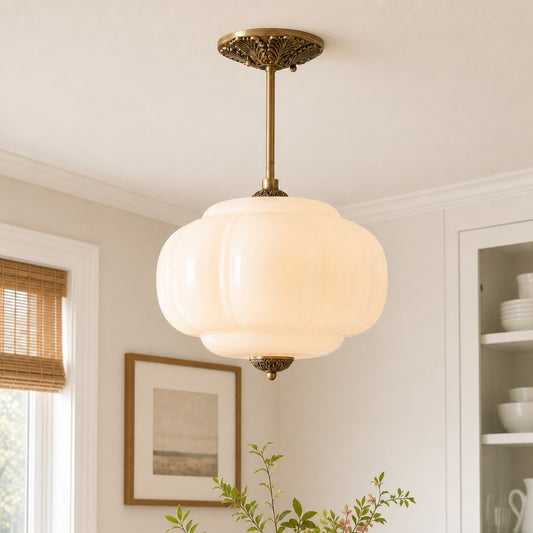
About the guidance: for additional planning checks, see the Merge Lighting Size & Installation guide. These are design guidelines, not electrical-code clearances. Product facts were checked against the linked listings; diagrams are calculated examples and listing photographs are not measured installations. The dedicated cover is an illustrative generated room.
Find a Pendant That Fits Your Measurements
Take your target drop and shade width into the selection process. Compare adjustable pendants, larger dining fixtures, or compact ceiling lights before choosing the final form.
Shop Pendant LampsExplore Dining ChandeliersBrowse Ceiling Lamps
Tags:
Previous
How to Use Ribbed Glass Wall Sconces in Bathrooms and Bedrooms
Next
Fluted Glass vs. Ribbed Glass Lighting: What's the Difference?