
Quick Chandelier Size Formula
Dining room chandelier size guide
Start with a round chandelier about one-half to two-thirds of your table's width, or of its diameter if the table is round. For a linear chandelier, start with one-half to two-thirds of the table's length, then check its width separately. Position the lowest part about 30-36 inches (2.5-3 ft / 76-91 cm) above the tabletop as an initial design range. Before ordering, confirm that the complete installed drop fits your ceiling and that seated sightlines remain open.
These are proportion guidelines, not electrical-code clearances. The right choice also depends on the fixture's shape, visual weight, light distribution, and exact installation instructions.
Round fixture
Diameter ≈ table width × 0.50 to 0.67
A 48 in (4 ft / 122 cm) round table gives a starting diameter of 24-32 in (61-81 cm).
Linear fixture
Length ≈ table length × 0.50 to 0.67
An 84 in (7 ft / 213 cm) table gives a starting length of 42-56 in (107-142 cm). This is length, not round diameter.
For a rectangular table, keep the round fixture comfortably inside the narrow sides. A room-size formula alone cannot tell you whether a chandelier will overwhelm a slim table. Begin with the furniture, then use the room's scale to decide whether an airy or more substantial form feels balanced. Compare silhouettes in the Chandeliers collection only after noting your target width and drop.

Different Table Sizes
Measure the tabletop edge to edge, excluding chairs. For a round table, use its diameter. For an oval or rectangular table, record both length and width. If an extension leaf stays in place most of the year, size the lighting around that everyday arrangement; also check the shorter configuration so the fixture never feels stranded beyond the table ends.
| Your dining table | Fixture size to explore |
|---|---|
| 36 in round 3 ft / 91 cm diameter |
Round chandelier: 18-24 in (46-61 cm) diameter. |
| 48 in round or square 4 ft / 122 cm across |
Round chandelier: 24-32 in (61-81 cm) diameter. |
| 60 in round 5 ft / 152 cm diameter |
Round chandelier: 30-40 in (76-102 cm) diameter. |
| 72 × 40 in rectangular 6 × 3.33 ft / 183 × 102 cm |
Round: about 20-27 in (51-69 cm) diameter. Linear: 36-48 in (91-122 cm) long; check crosswise width independently. |
| 84 × 42 in rectangular 7 × 3.5 ft / 213 × 107 cm |
Round: 21-28 in (53-71 cm) diameter. Linear: 42-56 in (107-142 cm) long; begin with a width no greater than about 28 in (71 cm). |
| 96 × 44 in rectangular 8 × 3.67 ft / 244 × 112 cm |
Round: about 22-29 in (56-74 cm) diameter. Linear: 48-64 in (122-163 cm) long. Compare a pendant row if the table ends need more coverage. |
The upper end is not automatically better. An open-arm fixture can appear lighter than a solid drum of the same diameter. Heavy glass tiers or opaque shades may call for a smaller silhouette. The round options above also do not guarantee even lighting across a long table; shape and beam distribution matter.
Turn the range into a real product shortlist
The Vienna Chandelier includes 19.7, 23.6, and 31.5 in round diameters (50, 60, and 80 cm). Its 31.5 in option falls near the upper end of the starting range for a 48 in round table. The 23.6 in size is a more compact possibility, close to the lower end. Mock up both before choosing how much presence you want.

For an 84 in rectangular table, the 47.2 in (120 cm) Pavilion Linear Chandelier sits inside the 42-56 in starting length range. Its listed width is just 1.8 in (4.5 cm), creating a very different visual effect from a broad circular chandelier. Compare the complete shape rather than treating equal lengths as equal visual weight.
Distance From the Tabletop
Start with 30-36 in (76-91 cm) between the finished tabletop and the chandelier's lowest point, including any finial or hanging glass. With a 30 in (76 cm) table, that places the bottom about 60-66 in (5-5.5 ft / 152-168 cm) above the floor. This range is for lighting over fixed furniture, not an open walking route.
Try a lightweight cardboard silhouette at 32 in (81 cm) above the table. Sit at both ends and along the sides. Check that you can see faces, that bulbs are not uncomfortably exposed, and that someone standing up does not meet an outer arm. Test the real table position and the centerpieces you normally use.
Overall installed drop = ceiling height − table height − tabletop clearance.
With an 8 ft ceiling: 96 − 30 − 32 = 34 in (2.83 ft / 86 cm). That 34 in allowance includes the canopy, suspension, connectors, and entire fixture body.

Do not raise a chandelier indefinitely to make an oversized fixture work. Check its diameter and bulb visibility first. For more examples of above-surface clearance, including how dining tables differ from islands, read our pendant hanging-height guide.
How Ceiling Height Changes the Choice
Low ceilings: check the minimum installed height
A compact body gives you more room for the mounting hardware, but it does not establish a low minimum drop by itself. Under an 8 ft ceiling, the 34 in example above must contain every part of the fixture. A tall body and a fixed rod can exceed that allowance even when the diameter is perfect.
The Montfaucon Chandelier lists a 7.9 in (20 cm) body height, with 31.5 and 39.4 in diameters (80 and 100 cm). Its shallow body is worth comparing for limited vertical space, but those widths still need a sufficiently broad table. Ask for the exact minimum installed drop; the supplied 59 in (150 cm) cable does not answer that question.

Tall ceilings: allow more suspension, then review body scale
Keep the table relationship as your first test. With a 10 ft (120 in / 305 cm) ceiling, a 30 in table and 32 in clearance, the required total drop becomes 58 in (4.83 ft / 147 cm). The extra ceiling height usually needs more suspension, not an automatic increase in diameter or a much higher position above dinner.
A deeper body can help fill the visual space if the complete assembly fits. For example, Vienna's 31.5 in diameter versions include a three-layer body at 13.8 in (35 cm) high and a four-layer body at 17.7 in (45 cm). You can change vertical presence without changing diameter. Neither body measurement confirms a 58 in overall drop; verify compatible suspension before ordering.
For a sloped ceiling, measure at the actual mounting point and confirm the product's approved mounting arrangement. Use a qualified electrician to check support, hardware, local requirements, and access for future cleaning. If the minimum drop cannot fit, review compact ceiling-light options rather than improvising shorter hardware.
One Chandelier vs. Multiple Pendants
Choose one round chandelier when you want a central focal point above a round, square, or shorter table. Choose a linear chandelier when an elongated form suits a long table. Compare multiple pendants when separate pools of light and a repeated rhythm work better. More fixtures mean additional mounting and alignment decisions.
| One chandelier | Two or more pendants |
|---|---|
| One composition centered on the table. A linear model can extend along a long tabletop. | Several light sources distributed along the table. Diameter, gaps, and end margins must work together. |
| Check canopy requirements and structural support for the whole fixture. | Confirm whether the design uses one multi-light canopy or separate electrical mounting points. |
| Good when you want one sculptural focal point. | Good when repetition and spacing are part of the design; avoid overcrowding a short table. |

Compare layouts with actual edge margins
On an 84 × 42 in (213 × 107 cm) table, a 48 in linear fixture leaves 18 in (46 cm) at each end. Two hypothetical 14 in (36 cm) pendants centered 21 in from the ends have 42 in (107 cm) between centers, 28 in (71 cm) between shade edges, and 14 in at the end edges. These are test layouts, not guaranteed light-coverage plans.

For identical pendants, clear gap = center-to-center spacing − shade diameter. A center measurement alone hides how close wide shades actually sit. Read the multi-pendant selection guide when choosing fixture count and mounting arrangements.
Choosing the Number of Lights
Choose the chandelier's physical fit first, then assess useful light. A six-light fixture is not necessarily brighter than a three-light model: bulb lumens, shade opacity, source direction, dimming, and the room's other lighting all change the result. Wattage describes power use, not a dependable brightness comparison across different lamps.
For a replaceable-bulb design, multiply the number of lamps by their rated lumens as an initial source-output comparison. Six 400-lumen bulbs total 2,400 nominal lamp lumens; three 800-lumen bulbs total the same amount. These are hypothetical examples, not specifications for the products shown. Shades and distribution determine how much of that light reaches the table.
The Tillary Wood Chandelier offers three-, five-, and eight-head versions, with listed lengths of 22.8, 29.9, and 35.4 in (58, 76, and 90 cm). Changing head count also changes its footprint. The listing labels those measurements as length, so confirm the full plan dimensions rather than assuming each number is a circular diameter.

For integrated LED fixtures, request rated fixture lumens and dimming information instead of counting decorative elements. The Pavilion listing specifies three-color switching and says it is not compatible with dimmers. Do not assume that color switching also provides brightness control. For a room used for both homework and quiet dinners, choose verified dimming or plan separate lighting circuits with your installer.
Assess the table and the surrounding room separately. A chandelier that lights dinner attractively may still leave a sideboard dark. Consider supporting wall lights or table lamps rather than increasing the chandelier's size just to illuminate every corner.
Common Mistakes
- Using table length as round diameter. A long table may suit an elongated fixture, but its narrow width still limits a round chandelier.
- Buying by room size alone. Center and size the fixture around the dining table, even when the table is off-center in the room.
- Confusing body height with installed drop. Include the canopy, connectors, suspension, and lowest decorative component.
- Assuming every rod or cable is freely adjustable. Confirm the exact variant's minimum and maximum installed height and approved extension options.
- Judging scale only from a photo. Lens perspective and room staging can disguise size. Use a full-size cardboard silhouette.
- Equating more heads with more usable light. Compare source output, distribution, and dimming as well as appearance.
- Forgetting the extended table or mounting location. Check everyday and occasional layouts before moving an electrical box.
Your five-minute measuring check
Write down table length, width, and height; ceiling height at the mounting point; target fixture width; and desired tabletop clearance. Calculate the total drop. Tape the footprint on the table, then hold a lightweight mock-up at the intended height and inspect it from every seat.
Share the dimensions and the selected product with your installer. The Merge Lighting Size & Installation guide helps organize the remaining mounting and product-specific checks.
FAQs
What size chandelier works over a 48-inch round table?
Start by testing 24-32 in (61-81 cm) in diameter. Move toward a lighter or smaller silhouette if the fixture is visually dense or the dining area is compact. The Vienna size options give you concrete dimensions to compare with your mock-up.
What size chandelier should I choose for a 72-inch table?
The width and shape matter too. For a 72 × 40 in rectangular table, begin around 20-27 in round diameter, or 36-48 in linear length, with a separate crosswise fit check. A 72 in round table would call for a different, larger starting range.
Can a chandelier be too small?
Yes, visually, though diameter alone does not establish brightness. A compact fixture can feel disconnected from a long table. Compare a linear silhouette or a balanced pendant row before simply choosing a larger circular light.
Does a higher ceiling mean I need a wider chandelier?
Not automatically. Table dimensions still guide the footprint. A higher ceiling increases suspension requirements and may support a deeper fixture body, provided sightlines and the complete installed drop work.
Is 30 inches above the table always correct?
No. It is the lower end of the 30-36 in starting range. Test actual seated views, fixture shape, glare, and the product instructions. Never apply this over-table range to an open walkway.
Should the chandelier match the table's shape?
It does not have to. A round chandelier can create a focal point above a rectangular table. For long tables, compare its light coverage with a linear chandelier or multiple pendants rather than relying on shape alone.
How do I convert the measurements?
One foot equals 12 inches; one inch equals exactly 2.54 cm. Multiply inches by 2.54 to get centimeters. The metric figures here are rounded for readability; use unrounded measurements when calculating a final installation.
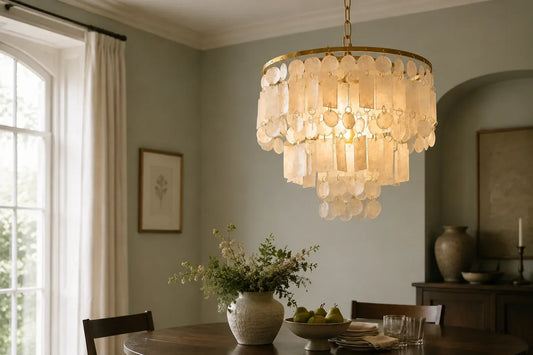
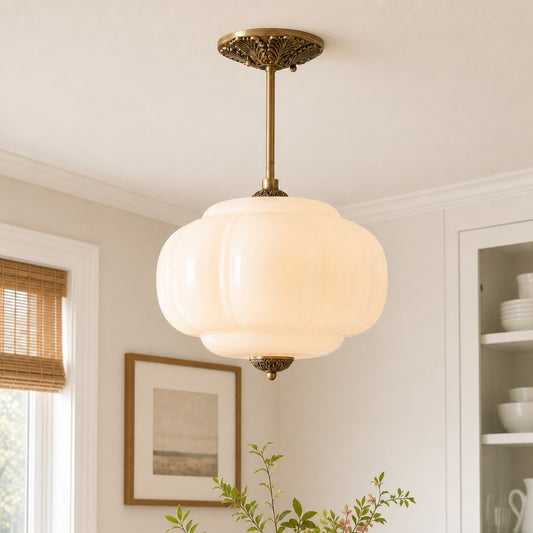
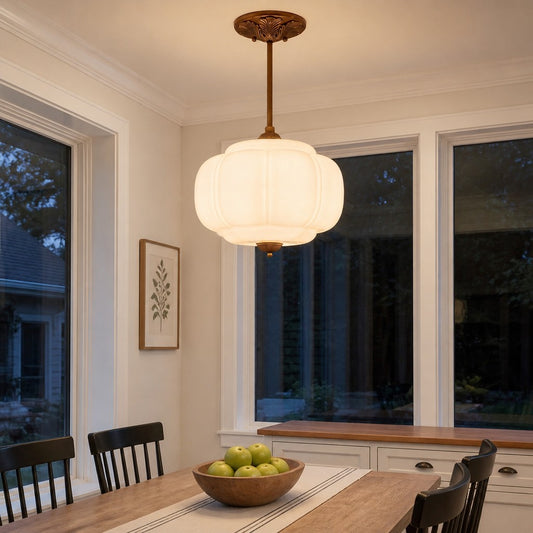
Product dimensions were checked against the linked Merge Lighting listings. Diagrams are original calculated planning examples; product photographs are visual references, not measured installations. The dedicated cover is an AI-generated room illustration based on the Vienna Chandelier.
Bring Your Measurements to the Selection
Find the right footprint first, then confirm the installed drop and lighting controls. Compare dining chandeliers, pendant arrangements, and compact ceiling lights with your table dimensions beside you.
Shop ChandeliersCompare Pendant LightsExplore Ceiling Lights
Tags: